Why Netmore is positioned to be the perfect partner for smart city growth
Netmore Group aims to help more communities become smart cities. The Polar Structure subsidiary builds and operates networks ideal for interconnected infrastructure and digital solutions that allow cities and municipalities to better manage resources and operate more efficiently.
Smart street lamps can use sensors to adapt lighting, keeping crosswalks and crowded areas bright while dimming where there’s no one around. Smart waste bins can report when they’re ready for pick up, ensuring garbage trucks follow optimized routes for targeted collection. Smart pest control systems can have sensors that track for signs of pests and pest-friendly conditions, catching infestations much earlier.
Such applications employ a high number of connected devices. The data transmitted is small and often sent via a low-power wide-area network (LPWAN), so device batteries can go decades between recharging or replacement. Within the Internet of Things (IoT) framework, this is known as “massive IoT”. It’s Netmore’s specialty, and the company has been highlighting its use for smart city initiatives more and more.
As Netmore Group’s CEO, Ove Anebygd notes in his introduction to the company’s recent whitepaper entitled Make the Connection: How LPWAN Technology Can Accelerate the Smart City Journey, “few concepts benefit more from the connectivity Netmore provides and the inflection points it creates than a smart city – especially technology solutions that make people’s lives better.”
Overcoming challenges of implementation
Smart city applications align with Netmore’s mission of enabling digital solutions to create a better, more sustainable future. The ones based on massive IoT typically address three core issues: resource scarcity, quality of life, and decarbonization. And things like smart lighting, smart waste management, and smart pest control arguably help tackle all three.
Yet despite the benefits, communities often face challenges when implementing massive IoT-based smart city solutions. Budgetary constraints, deployment difficulties, and a lack of tailored solutions are common and frequently hinder or derail initiatives.
Netmore’s services, however, provide a way to overcome those challenges. Among the various types of LPWAN communication the company utilizes is the Long Range Wide Area Network (LoRaWAN) protocol.
First launched over a decade ago, LoRaWAN is an established networking technology with unique features in terms of performance, security, and affordability that make it relatively easy to deploy and have a notably high ROI for smart city applications.
Netmore supports multiple LPWAN technologies. Its technology is a neutral, interoperable platform for massive IoT that provides significant advantages to municipalities wanting to deploy a diverse set of applications. Yet the company’s foundational roots are in LoRaWAN, which remains a major part of its networking infrastructure. And for good reason.
Unlike other LPWAN communication protocols, there’s a strong global community of LoRaWAN developers constantly creating, releasing, and updating products. This creates a broad field of potential solutions to be mixed and matched into a customized smart city strategy, but enables the addition of solutions in the future that can’t be foreseen.
But, perhaps, the greatest benefit for communities that partner with Netmore for smart city initiatives is that the application devices can be added to networks already in place.
One single network is enough
Supporting smart city initiatives is how Netmore is bridging the gap between those for whom it builds networks and those who can use them as well.
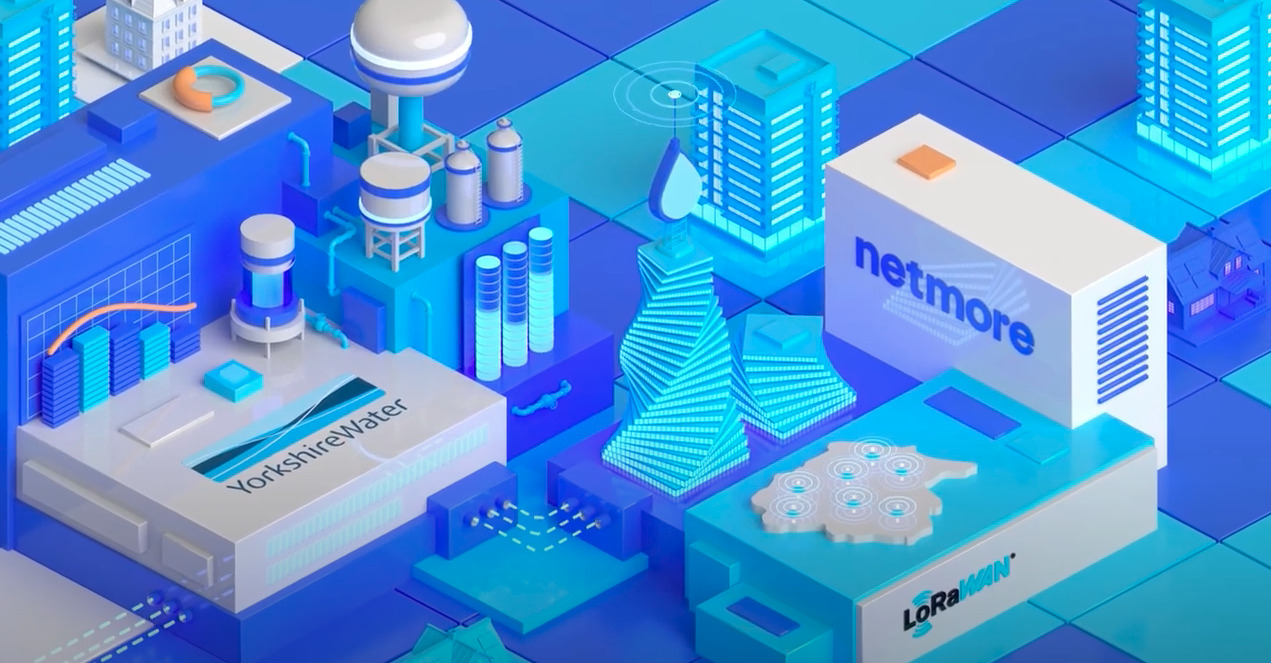
Over the last few years, the company has had significant success in smart metering. In northern England, for example, it’s currently installing and connecting just over 1.5 million smart meters for Yorkshire Water. And less than a month after publishing its smart city whitepaper, Netmore announced it had closed a contract with Severn Trent, the second-largest water utility in the United Kingdom, to lead a similar effort for 1 million smart meters.
Smart water meters, like the ones for Yorkshire Water and Severn Trent, collect data to improve operations, bill customers more accurately, and reduce water loss through leak detection. And installing them requires deploying a LoRaWAN network, which can connect many more devices other than smart meters. With an experienced operator like Netmore, such a network can be opened up for other uses without affecting the original applications.
So a single dense network deployed for an anchor application, like water metering or other IoT-based smart meter, can be utilized for an endless number of applications. This allows many communities to sidestep the initial financial burden of deploying an LPWAN network. Once the network is up, they can just connect to Netmore and begin their smart city journey with serious velocity.
Related posts

New commercial agreement for near-zero emission cement
Vattenfall and Cemvision have signed a commercial agreement marking an important step in the transition of both the energy and construction sectors. T...
Read more
Railway connection completed – driving Boden’s industrial future
Railway connection completed – driving Boden’s industrial future The new railway connection to Boden Industrial Park has been fully completed – one...
Read more
How Netmore is expanding its global influence while strengthening local impact
The Netmore Group often pitches its services as drivers for growth. The Polar Structure subsidiary specializes in enabling millions of wireless device...
Read more